Introduction

Prior to the launch of the decentralized "Alpha" Grant Round, the Gitcoin team was experimenting with a tool called "Trust Bonus". This tool gave users the ability to multiply their donations by verifying their identity. However, it was built using an inaccurate aggregate model with no true data-science to back it up. Users would connect their Gmail, Twitter, and Facebook using Auth0 and “the system” would allegedly match a percentage of the donation (50% to 150%) per verified account.

I worked closely with the data team to conduct cross-analysis to identify patterns, trends, and correlations between different verification variables, and understand how each verification affected matching results and funds distribution. The most alarming insight was the number of fake/shell accounts, revealing a massive security risk and ease to manipulate results for distribution of capital. Any bad actor could create fake projects, fake emails, and fake social media accounts to ask for donations. Some of the more elaborate schemes uncovered the utilization of bots and click farms to multiply the donations made by their own sybil networks.

My focus shifted to evolve Trust Bonus, by transforming it into a decentralized attestations aggregator web-app that enabled a plurality of sybil prevention mechanisms.
Role
Lead Product Designer
Duration
12 Months
Solutions
Web App & Design System

The Approach

User feedback was at the core of understanding user needs and was gathered from multiple funnels (twitter, discord, & governance/post comments). I worked closely with engineering, community support, an data teams to uncovered significant opportunities that later defined our suite of products.

My initial insights pointed to 4 key goals for contributors: to remain anonymous, to verify stamps quickly, clarity on what stamps were needed to gain access, and clarity on which stamps had the highest reward. As well as 4 key goals for community operators: to grain trust from active contributors, to protect their community from bots/bad actors, to customize stamp requirements, and to choose a scoring mechanism that aligned with their goals.

My research branched out to organizations like Bankless, Optimism, and Guild.xyz. After about six weeks of rapid prototyping and testing what a standalone product could look like; we landed on a user experience that met both persona needs and was scalable. Our insights also opened the door for a separate tool that allowed communities a way to establish attestation requirements; in order to integrate Passport based on their individual needs. This came to be known as the Passport Scorer.

The Solution

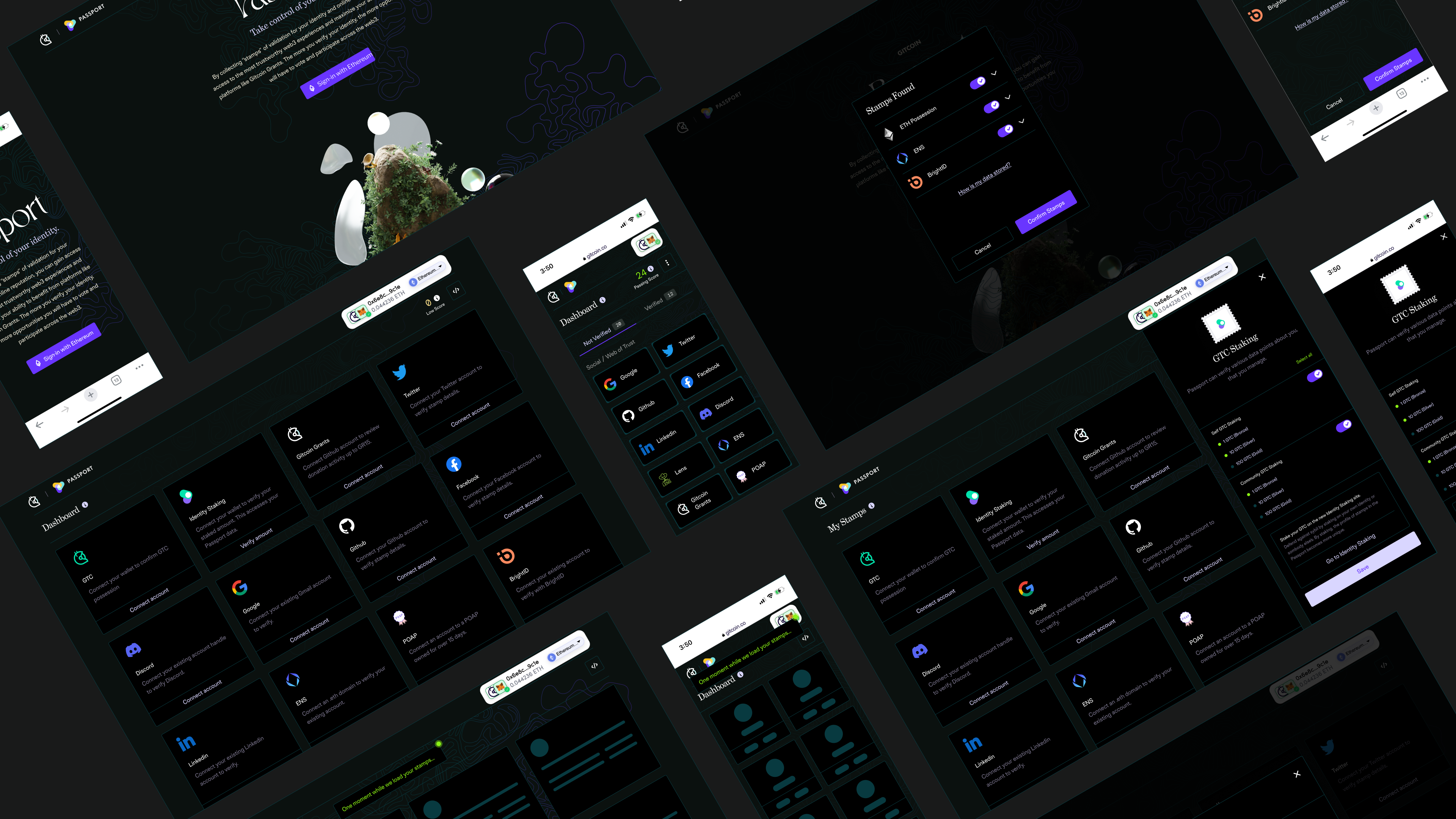
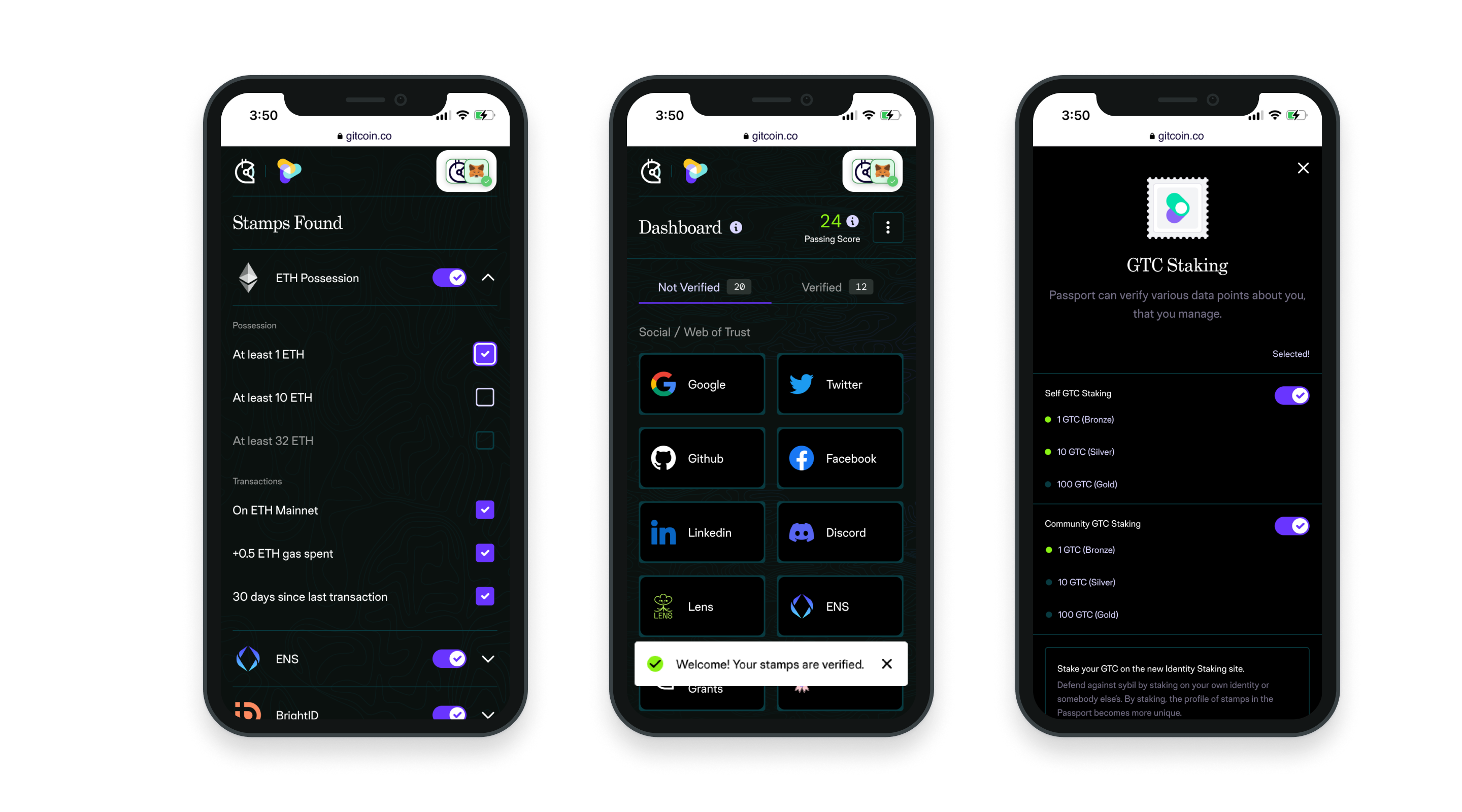
The Gitcoin Passport allowed users to verify Stamps which consisted of KYC, asset ownership, purchase statements, reputation badges, community votes, financial status, credentials, and provenance. We experimented with different ways to display progress and incentivize users to verify more Stamps through gamification. We landed on the concept of a unique humanity score which could be used to grant passing users access into specific DAOs and communities.

This gamified reframing brought massive engagement with thousands of new and existing users creating Passports to collect Stamps, join communities, and fund their favorite projects.

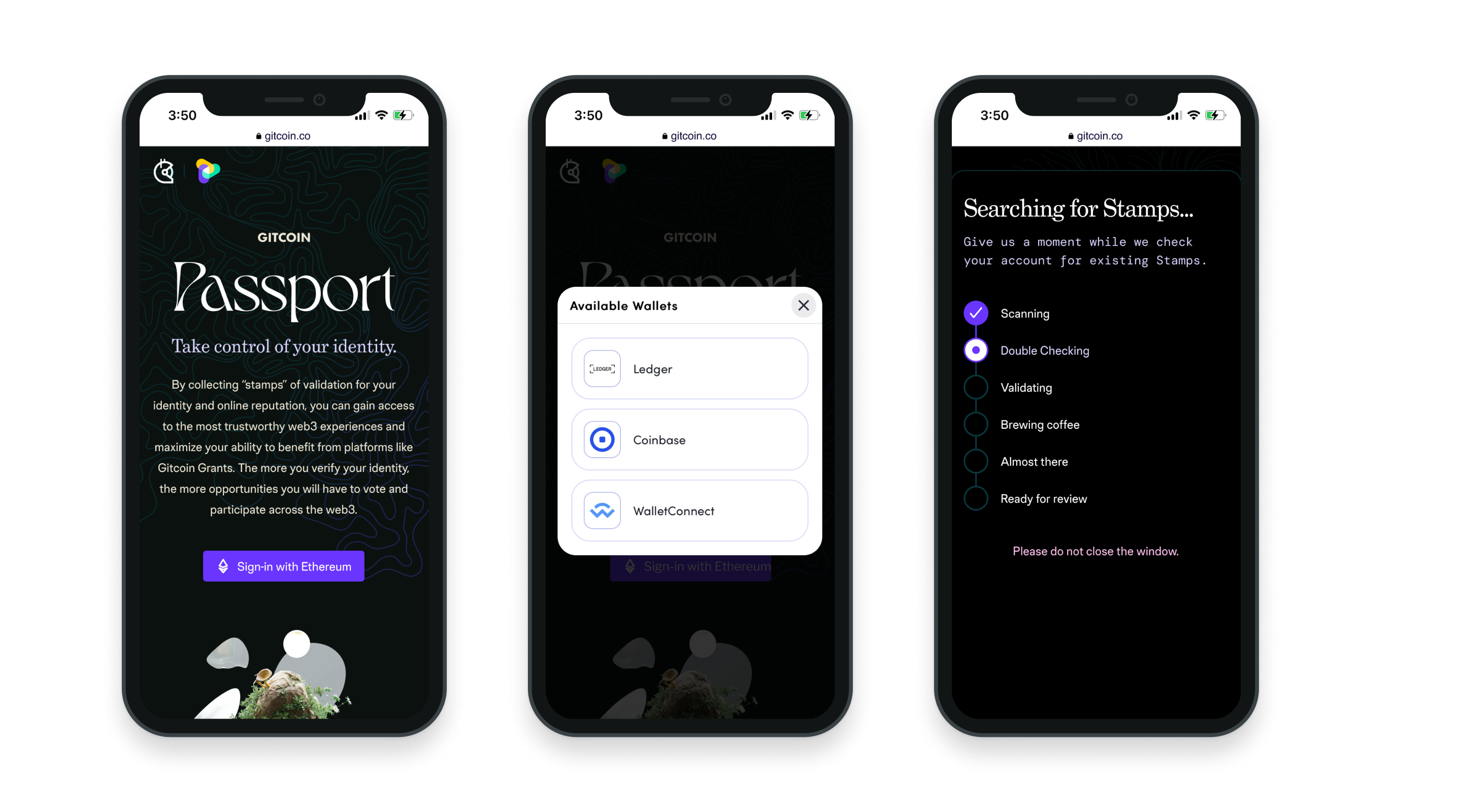
Additionally, we shortened time on task for account creation by leveraging Metamask (the most popular wallet) resulting in a 45% time-spent reduction from 5 minutes to under 3. I also created the 'One-click verification' which extracted all on-chain data attached to a wallet to mass validate any relevant data points as stamps. The result was a 700% optimization in time spent per stamp: from 2 minutes per stamp to less than 1 per 4 stamps on average.

The Lessons

The Gitcoin Passport was a success in significantly lowering sibyl attacks and fraudulent behavior during subsequent Gitcoin grant rounds. More recently, the protocol has been used in different parts of the world for election transparency, community gatekeeping, and system validation at scale. Distilling something so abstract and complex, into a gamified experience was a true joy and honor. Seeing the impact and ripple effects it has had in the Ethereum ecosystem makes my contribution all the more satisfying, as Ethereum moves one step closer to being a transparent, trustworthy, and secure network.

One of the biggest takeaways is how complex account abstraction and reputation can be when it comes to consumer applications. The mathematical complexity that went into creating a data-backed humanity score and articulating it's logic, was too difficult for the average user to understand. Users should not have to work so hard to learn what's expected of them to prove they are real and trustworthy. Looking back I wish I would've explored the massive opportunity in encrypted biometrics and retina scans as a more pragmatic approach to humanity verification.
Purdue graduate, storyteller, guacamole maker, & entrepreneurial thinker.
View Resume